Monday, 26 August 2013

To bee or not to bee

There is suggested by Ritzer & Jurgenson (2010) a new form of prosumer capitalism developing out of traditional capitalism with differing characteristics. Distinguishing itself from Mcdonaldisation or the “traditional prosumers” that have developed as result of consumption out weighing production in developed society and where production is contributed to in part by the consumer to maximise surplus. Making your order in detail ahead of time the way you like it paying at a counter cleaning up afterwards for example.

Whereas the traditional prosumer is more of an extension of capitalism finding ways of minimising costs the new prosumer almost eliminates costs to the point of contributing “nothing but surplus” (Ritzer & Jurgenson 2010). To apply this alternative prosumer model to a beehive the beekeeper is the hand of capitalism where the bees work for free.

The newer form prosumer has everything to do with web 2.0 and online contributions of labour through content creation changing the prosumer in 4 new ways.

1. Apparently open, minimally controlled by capitalists

2. Exploitation becomes more of an ambiguous issue

3. Possibility of a new economic form out of building brands/ competitive advantage

4. Abundance instead of scarcity means quality over efficiency

The role of a beekeeper is to maintain a hive through keeping bees busy. The process involves taking a full honeycomb frame out and adding a fresh blank frame with a starter sheet of beeswax honeycomb foundation to the hive for the bees to use as a platform to build upon and keeps a single hive happily building neat honeycomb rows.


Frames with foundation available from Redpaths Beekeeping Supplies

As a result the queen lays more workers and less queen cells making problem swarms less likely and the beekeeper can keep the surplus skimming off the top some delicious honey. The web 2.0 example of a prosumer contributing the bulk of production of content freely online has made me perhaps obviously jump to this straight forward comparison.

The network of the web visualised as a hive with frames with honey comb sheets being platforms such as Wikipedia, YouTube and Facebook has an interesting perspective to it in many ways more than this. The similarly apparently open, ambiguously exploitative, possibilities for new economic forms and abundance are all linked to the way beekeeping works too.

Sources: 

Photo: http://www.redpaths.com.au/images/PROD_4737_.jpg

Ritzer, George and Jurgenson, Nathan 2010 ‘Production, Consumption, Prosumption: The nature of capitalism in the age of the digital ‘prosumer’, Journal of Consumer Culture, vol. 10 no. 1, pp 13-36.

CCD: Colony collapse disorder

The tactics corporations use to manipulate or spin the perception of situations can make a difference to the moral outrage towards a phenomena where right and wrong might have been ambiguous and complex. Specifically here we are talking about one of many strategies employed classified as devaluation versus validation according to Martin, Moore & Salter (2010).

“Good guys” and “bad guys” can be clearly depicted by the powerful corporations to simplify the various arguments streamlining an issue to their advantage. File sharing for example so called pirates are repeatedly compared to car thieves and shoplifters. The devaluation of file sharers as criminals was the main initial method employed by the music industry (Martin, Moore & Salter 2010). The advocates of file sharing were demonised to defend the industry position and decisions made punishing individuals involved as just.

Me with a bee!
Within the beekeeping industry the strategy of devaluation versus validation is also utilised to defend the position of pesticide companies and world-wide farming practices. The factors affecting the beekeeping industry are shaped more subtly however than the example of file sharing.

Colony collapse disorder is a global problem affecting beekeepers causing devastating losses to commercial beekeeping operations up to 50 percent decreases in bee populations in the US (vanEngelsdorp et al. 2008). The exact cause for the problem which involves the abandonment of the hive and subsequent death of large numbers of bees is unknown precisely, however the role of pesticides and fungicides, a likely cause, is defended voraciously within the beekeeping industry and from other interests.
My little buddy

The effects of pesticides and fungicides is often the last contributing factor if at all behind the varroa mite, electromagnetic radiation, fungus, genetics, habitat loss, poor nutrition and beekeeping practises such as transportation. Agricultural spraying practices are defended as embedded in the landscape of primary industry and simply inconclusive as a factor despite the growing evidence that pesticides and fungicides are having significant link (Woody, 2013).

Spending thousands per year treating varroa mite and improving beekeeper practices, feeding bees and breeding better genetics is repeatedly reported as being the only solutions in conferences and beekeeping journals and then those solutions are often the only advice given from beekeeping supplies businesses such as where I work rather than tackling the widespread problem of pesticides and fungicides impact in the equation.

Martin, B, Moore, C and Salter, C. (2010), “Sharing music files: tactics of a challenge to the industry”, First Monday, vol. 15, no. 12, http://firstmonday.org/htbin/cgiwrap/bin/ojs/index.php/fm/article/view/2986/2680

Woody, T. (2013) “Scientists discover what’s killing the bees and it’s worse than you thought”, Quartz, 24 July, 2013

vanEngelsdorp D, Hayes J Jr, Underwood RM, Pettis J (2008) “A Survey of Honey Bee Colony Losses in the U.S., Fall 2007 to Spring 2008”, PLoS ONE 3(12): e4071. doi:10.1371/journal.pone.0004071

Tuesday, 6 August 2013

Don't make the bees angry

What art movement or art genre, type, style or sub-culture has influenced or changed the way you view a culture other than you own? How and why?

Following my theme and reinforcing the concepts introduced this week today the subject similarly brings bees and sculpture together but perhaps in a more thoughtful way than to shape a bottle of scotch out of beeswax for an advertisement.

Thomas Libertiny is a Slovakian artist that regards beeswax as a "material that counters the slickness and chilliness” of modernist design (Jeffries 2012). He is rejecting the industrial mass produced Fordist design by utilising nature rather than man made processes.  

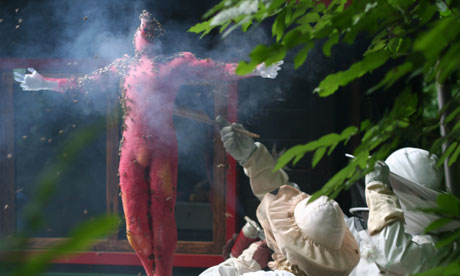
Using beeswax and live bees his 2009 work Unbearable Lightness used the frame of a standing figure of christ and involved dying the food of the 40,000 contributing bees red resulting in a red honey filled figure of a martyred christ. The work winning him the Art Basel Designer of the Future award.

Libertiny's piece "Unbearable Lightness" Source: The Guardian

Libertiny is acting against modernist industrial design by reflecting a human element through dying the bees food source red. The bees don't notice though as they cannot perceive the colour difference. Such an imperceptible change to the micro level material involved in the bees technological process of manufacturing honey results in a dramatic change overall.     

The delicate balance of the process and product he creates could be seen as a reflection of the fragility and reconfiguration involved with globalisation. According to Nederveen Pieterse "globalisation is a macro-economic phenomenon driven by micro-economic forces,"(Nederveen Pieterse 2004) Although he is describing economic factors, here the demonstration is of a model where there is a micro level forces re-configuring the technology of the bee to scale up to a huge macro level shift.   

In his work Libertiny is attempting to also raise awareness of the decline of the honeybee due to colony collapse disorder a mysterious problem worldwide where bees simply disappear due to a possible mixture of poisonous pesticides, verroa mite, habitat loss and poor nutrition as well as changing patterns in bee migratory behaviour.

"The Honeycomb Vase" Source: Crafts magazine


“It comes from flowers and, in the form of a vase, ends up serving flowers on their last journey.” Says Libertiny referencing his work above.(Jeffries 201
2) This compression and intensification by human hands of an other wise natural process chills me strangely. I think because it almost mocks the beauty of the process. 

What do you think? Could globalisation result in our processes encasing us on our last journey? Or are you more positive than me.
 

Gibson, G 'Telling Tales at the V&A' http://www.craftscouncil.org.uk/crafts-magazine/reviews/view/2009/telling-tales-at-the-va?from=/crafts-magazine/reviews/list/2009/


Jeffries, S 2012, 'Hive talking: Tomás Libertíny's bee art,' The Guardian, 10 July 
http://www.theguardian.com/artanddesign/2012/jul/09/tomas-libertiny-bee-living-sculpture

Nederveen Pieterse, J 2004, ‘Globalization: consensus and controversies’, Globalization and culture: global mélange, Rowan & Littlefield, Lanham, p. 10